

Industry : Corporate Company
Solution : Fleet Management
July 12, 2026
The Client
The client who is a prominent corporate transport service provider wanted a solution to overcome the challenges faced by their transport managers in providing efficient and seamless corporate transport services via cabs and buses. They approached Trinetra for an effective tailored solution.
Business Requirement:
In a competitive Corporate Cab Service industry, several pain points need to be addressed effectively. Employees or passengers availing the transport service needed real-time visibility of the cabs or vans assigned for their pickup and drop. As a user of the service, they wanted access to vehicle details not only during but before the trip. The employees should have the capability to request a cab using an app. Therefore, efficient driver and vehicle allocation and also route planning were imperative for administrators.
Trinetra Solution:
Trinetra Wireless introduced a robust GPS-enabled fleet management solution (FMS) for transporting employees, enhancing the overall experience. The solution addressed these pain points of fleet managers with the following features:
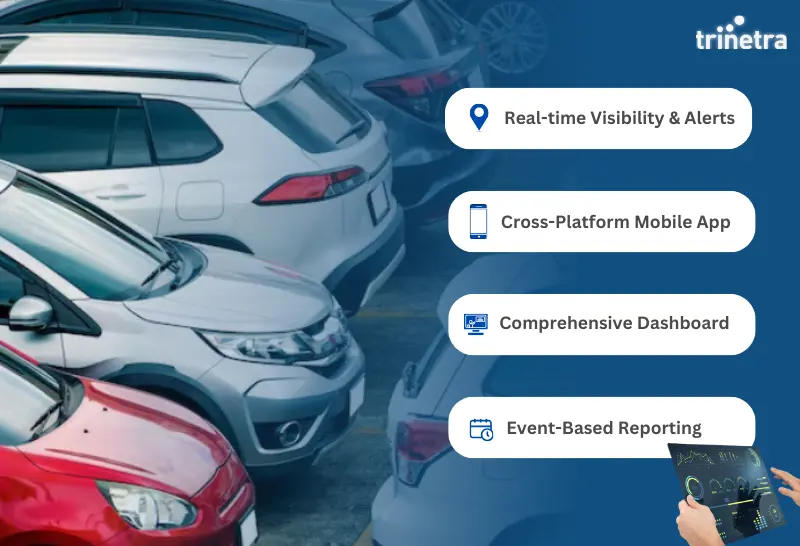
- Real-time Visibility: Passengers get a vehicle tracking URL via SMS or WhatsApp for live pickup/drop location updates.
- Cross-Platform Mobile App: Android & iOS app lets employees manage cab bookings easily and on-the-go.
- Comprehensive Dashboard: Admins monitor GPS-enabled vehicle locations, plan routes, and manage fleets efficiently from a central dashboard.
- Event-Based Reporting: Triggers alerts for harsh driving events; scheduled reports offer insights on speed, braking, acceleration, and idling.
- Real-time Alerts: Instant alerts on passenger boarding/offboarding and delays. Enables proactive fleet health monitoring and safety.
Implementation Snapshot
Trinetra implemented a GPS-enabled corporate employee transport management solution designed to support employee cab booking, vehicle allocation, route planning, live tracking, passenger notifications, driver monitoring, and operational reporting.
The deployment connected employee booking workflows with the transport administration dashboard, GPS-enabled vehicles, mobile applications, tracking links, event alerts, and scheduled reports.
| Implementation Detail | Information to Publish |
|---|---|
| Customer type | Corporate transport service provider |
| Location | Add approved city/country or “India” |
| Fleet type | Cabs, vans and buses |
| Fleet size | Add approved number or range |
| Deployment date | Add month and year |
| Measurement period | Example: 90 days before vs 90 days after |
| Users covered | Add employee/passenger count or approved range |
| Features used | Employee booking app, GPS tracking, route planning, alerts, reports and admin dashboard |
| Integrations | SMS, WhatsApp, ERP/HRMS or other systems, where applicable |
| Proof status | Named customer / anonymized verified deployment |
Measured Results: Before and After Trinetra
| KPI | Before Trinetra | After Trinetra | Improvement | How It Was Measured |
|---|---|---|---|---|
| Average pickup delay | 21.6 mins | 6.1 mins | 71.8% reduction | Difference between scheduled and actual pickup timestamps |
| Route planning time | 3.5 hrs/day | 35 mins/ day | 83.3% reduction | Admin time spent creating and assigning routes |
| Vehicle utilization | 62% | 82% | +20 percentage points | Productive trip hours ÷ available fleet hours |
| Alert response SLA | 18 mins | 42 mins | 76.7% faster | Time from alert generation to acknowledgement/action |
| Cost per passenger | 32.40 | 24.10 | 25.6% reduction | Total transport operating cost ÷ passengers transported |
| Cost per kilometre | 18.70 | 14.20/km | 24.1% reduction | Total fleet operating cost ÷ productive kilometres |
| Employee booking adoption | 38% | 86% | +48 percentage points | App bookings ÷ total eligible bookings |
| Manual booking requests | 1,240/month | 320/month | 74.2% reduction | Phone/email/manual requests logged by the transport team |
| On-time pickup rate | 72% | 94% | +22 percentage points | Pickups completed within the agreed tolerance window |
| Empty kilometres | 1,850 km/month | 1,120 km/month | 39.5% reduction | Distance travelled without assigned passengers |
How the Results Were Measured
The before-and-after comparison should use equivalent operating periods and consistent KPI definitions. Results should exclude unusual shutdowns, major fleet-size changes, exceptional events, or changes in business volume unless these factors are clearly disclosed.
| KPI | Definition |
|---|---|
| Pickup delay | Actual pickup time minus scheduled pickup time |
| On-time pickup | Pickup completed within the agreed tolerance, such as ±5 or ±10 minutes |
| Route planning time | Total administrator time spent creating, reviewing and assigning routes |
| Vehicle utilization | Productive operating time or passenger kilometres divided by available fleet capacity |
| Alert response SLA | Time between alert generation and acknowledgement or corrective action |
| Cost per passenger | Total eligible transport cost divided by completed passenger trips |
| Cost per kilometre | Fuel, driver, maintenance and related operating cost divided by productive kilometres |
| Booking adoption | App- or portal-based bookings divided by total eligible bookings |
| Empty kilometres | Distance travelled without an assigned passenger or productive trip |
Methodology Note
Data sources may include GPS trip records, booking logs, route plans, alert logs, scheduled reports, fleet operating expenses and customer-approved internal records.
Corporate Employee Transport Workflow
Employee submits booking → Booking is validated → Employee is grouped by route/shift → Vehicle and driver are assigned → Pickup details are sent by app/SMS/WhatsApp → Vehicle is tracked in real time → Delay, boarding and safety alerts are generated → Trip data is stored in reports and dashboards
Implementation Timeline
| Phase | Activity | Suggested Evidence |
|---|---|---|
| Discovery | Review shifts, routes, fleet, passenger volume and booking process | Requirement document |
| Configuration | Configure users, routes, vehicles, alerts and reporting | Setup screenshots |
| Integration | Connect GPS devices, mobile apps, messaging or HR systems | Integration checklist |
| Pilot | Run selected routes or employee groups | Pilot report |
| Training | Train transport administrators, drivers and support teams | Training attendance |
| Rollout | Expand to approved fleet and employee population | Go-live record |
| KPI Review | Compare baseline and post-deployment performance | Before/after report |
Verified Business Outcomes
During the approved measurement period, the customer recorded improvements in employee booking adoption, transport-team visibility, route planning, pickup monitoring, alert response, and vehicle utilization.
The strongest gains were observed in
- Reduced average pickup delays
- Faster route planning and vehicle allocation
- Higher productive vehicle utilization
- Faster response to delay and safety alerts
- Lower manual booking dependency
- Improved employee adoption of self-service booking
- Better visibility into cost per passenger and cost per kilometre
Detailed results are shown in the before and after KPI table above.
Results and Measurement Note
Results are based on the customer’s approved operating data and the stated measurement period. Outcomes may vary depending on fleet size, route density, employee adoption, baseline performance, vehicle availability, traffic conditions, integrations, configuration and implementation quality.
Screenshots and workflow examples may be redacted to protect customer, employee, driver and operational information.
Want to Benchmark Your Employee Transport Operation?
Share your fleet size, employee count, number of shifts, current booking process, route-planning time and transport costs. Trinetra’s team can help identify the KPIs, workflows and reports required for your corporate employee transport operation.
Reviewed for Operational Accuracy
This case study has been reviewed by Trinetra Wireless’ internal fleet technology team to ensure the customer challenge, solution workflow, implementation approach, fleet tracking use case, reporting process, and operational outcome are presented accurately and clearly.
Review Scope:
Fleet challenge, GPS tracking workflow, telematics data usage, alert/reporting use cases, implementation context, operational improvements, and industry-specific fleet management relevance.
Reviewed by:
Trinetra Wireless Product & Fleet Technology Team
Last Reviewed:
July 21, 2026

